



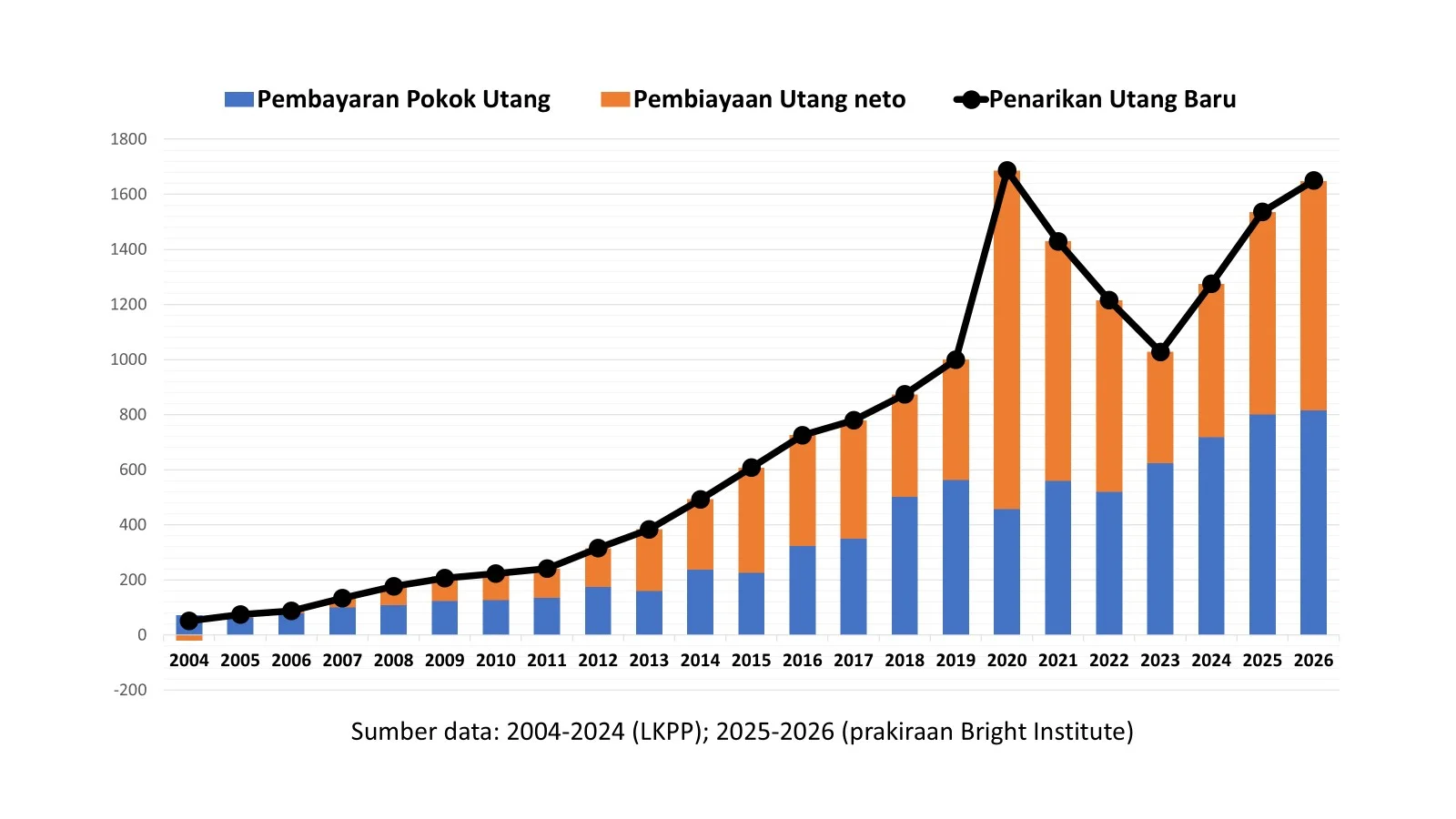
Questions surrounding national financial health and state budget financing limits have once again returned to the public spotlight amid shifting global economic dynamics. According to the latest official data from the Directorate General of Budget Financing and Risk Management at the Ministry of Finance, the indonesian government debt position reached Rp9,920.42 trillion as of March 31, 2026. This figure, moving progressively closer to the ten-thousand-trillion-rupiah threshold, has sparked diverse public commentary regarding the overall stability of the national balance sheet.
This financial obligation level represents a debt-to-Gross Domestic Product (GDP) ratio of 40.75 percent. Of the total outstanding obligations, the vast majority is composed of Government Securities (SBN) amounting to Rp8,652.89 trillion, while direct loans account for Rp1,267.52 trillion.
However, a rising nominal debt figure does not automatically signify that the state’s public finances are in a state of crisis. Evaluating sovereign fiscal health requires a structured examination of financing instrument composition, economic growth metrics, and the productive utilization of borrowed capital.
Structure of National Budget Financing and Domestic Securities Dominance
The trajectory of sovereign liabilities shows an upward trend when compared to the figures recorded at the end of the previous fiscal year. At the close of 2025, total obligations stood at approximately Rp9,637.90 trillion, indicating an increase of around Rp282.52 trillion through the first quarter of this year. This adjustment in the indonesian government debt position is directly linked to annual state budget deficit coverage and long-term national development financing requirements.
The Ministry of Finance confirms that debt issuance remains a calculated and controlled instrument within macro-budgetary management. The primary objective of liability management is to secure an optimal portfolio mix while simultaneously driving the growth and depth of domestic capital markets.
The heavy reliance on Government Securities—accounting for 87.22 percent of total debt—highlights a strategic shift toward domestic capital market mechanisms over direct foreign borrowing. Bilateral and multilateral loans now comprise only a minor portion of the government’s overall liability portfolio.
Periodic budget reports through the end of June 2026 indicate that net debt financing reached Rp477.4 trillion, representing roughly 57.4 percent of the full-year target set at Rp832.2 trillion. This net financing metric represents new borrowing inflows during the period, distinguishing it technically from total outstanding debt stock.
Debt-to-GDP Ratios, Deficit Management, and Sovereign Stability
A primary benchmark utilized by international credit rating agencies to evaluate sovereign debt sustainability is the debt-to-GDP ratio. Standing at 40.75 percent, the indonesian government debt position remains comfortably below the statutory limit of 60 percent mandated by state finance laws. Fiscal authorities maintain that current liability levels remain within a prudent and manageable corridor.
Despite maintaining a safe ratio, sovereign debt management demands ongoing caution and strategic foresight. The government remains obligated to ensure that borrowed capital is channeled primarily toward productive infrastructure and economic capacity projects that yield sustainable multiplier effects.
First-half execution of the 2026 state budget recorded government revenue at Rp1,459.4 trillion against state expenditure of Rp1,656 trillion. This structural gap produced a fiscal deficit of Rp196.5 trillion, or approximately 0.76 percent of GDP during the first six months.
To maintain fiscal stability through the remainder of the fiscal year, authorities project the full-year budget deficit to settle around 2.85 percent of GDP. The presence of this deficit underscores why ongoing financing remains necessary to bridge the gap between revenue collection and national development spending.
Public misconceptions that attempt to simplify total sovereign debt by dividing it evenly as an individual liability per citizen remain statistically inaccurate. State debt is managed centrally through the national budget and serviced using fiscal revenue derived from taxation and non-tax state receipts.
An objective assessment of the indonesian government debt position requires a comprehensive perspective encompassing GDP growth rates, revenue generation capacity, and spending efficiency. Maintaining disciplined fiscal governance remains essential to preserving economic stability and long-term national competitiveness.