



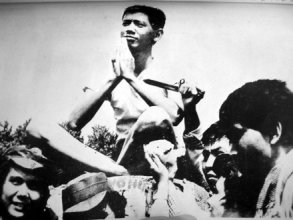
National celebrations marking the birth of a sovereign state are frequently accompanied by exuberant festivities and symbolic ceremonies across the country. Yet, beneath the grand stage of national history, the true substance of national sovereignty demands continuous critical re-examination. Analyzing the soe-hok-gie-freedom-philosophy invites us into a deeper realm of intellectual reflection, where independence is defined not merely as the end of colonial rule, but as a perpetual moral commitment to becoming an individual of courage, inner liberty, and unyielding dedication to justice.
Soe Hok Gie remains a widely recognized figure in modern Indonesian history as a student activist, prolific writer, and young intellectual who maintained a fiercely critical stance toward the socio-political dynamics of his era.
His ideas and intellectual struggles are meticulously documented in his famous work Catatan Seorang Demonstran (Diary of a Demonstrator), a collection of personal journal entries capturing his sharp observations on power structures, societal conditions, and the struggle against systemic oppression.
For the young scholar, personal liberty was intrinsically linked to freedom of thought and the courage to articulate truth, even when doing so meant standing in direct opposition to prevailing majority opinions.
Intellectual Liberty, Moral Courage, and Universal Human Dignity
A central pillar within the Soe Hok Gie intellectual legacy is his firm rejection of apathy and the widespread tendency of individuals to passively accept dominant political narratives. An individual may reside within a legally independent nation, yet their inner self remains constrained if they hesitate to exercise independent rationality.
Consequently, any meaningful examination of the soe-hok-gie-freedom-philosophy places intellectual autonomy at the absolute apex of true citizenship.
Historical records preserved by the HuMa Library highlight how Gie consistently rooted his sharp critiques of government policies in universal human rights and social justice. For Gie, genuine patriotism was never demonstrated through blind obedience to authority, but rather through the moral courage to offer honest criticism whenever injustice manifested within society.
Alongside the bravery to speak out, true liberty remains indivisible from respect for human dignity. Freedom must never be misused to justify arbitrary actions or oppress the rights of marginalized groups.
Academic studies analyzing Gie’s philosophical contributions emphasize his view of human beings as sovereign entities endowed with fundamental rights to flourish. Thus, individual sovereignty fulfills its highest purpose when channeled toward mutual understanding, empathy, and advocating equity for others.
Uncompromising Principles and Contemporary Moral Relevance
The defining hallmark of Soe Hok Gie’s legacy was his unwavering moral posture and complete refusal to compromise with injustice. Educational materials published by the Directorate of Senior High Schools under the Ministry of Primary and Secondary Education depict Gie as an exemplar of youth integrity who consistently prioritized public interest over personal ambition, particularly when advocating for disenfranchised communities.
This moral consistency serves as a powerful reminder that the soe-hok-gie-freedom-philosophy demands the fortitude to preserve core ethical principles despite social pressure or immediate personal gain.
In a contemporary era shaped by massive information flows and digital saturation, the insights of this young intellectual resonate with heightened urgency for future generations. Modern challenges no longer take the form of armed military conflict on physical battlefields, but rather manifest as battles against disinformation, deceptive narratives, and the erosion of public critical thinking.
Younger generations are called upon to cultivate digital literacy to filter information rationally, distinguish empirical arguments from subjective opinions, and adopt principled positions in civic life.
Social responsibility does not always require grand public demonstrations. The reflective essays in Catatan Seorang Demonstran demonstrate how daily contemplation, rigorous academic inquiry, and active concern for one’s immediate community represent tangible practices of true independence.
Sustaining this critical awareness ensures that hard-won political liberties do not decay into dangerous civic complacency.
Nurturing the soe-hok-gie-freedom-philosophy across generations requires preserving the courage to think critically, uphold social justice, and deploy personal freedom in service of the broader public good.
Ultimate liberation remains a continuous journey, where every generation is challenged to defend moral integrity while expanding the meaningful impact of their freedom for the benefit of humanity.